 Ray Ann Bucu
The archive →
Ray Ann Bucu
The archive →
Book two · Symbolism and cultural change
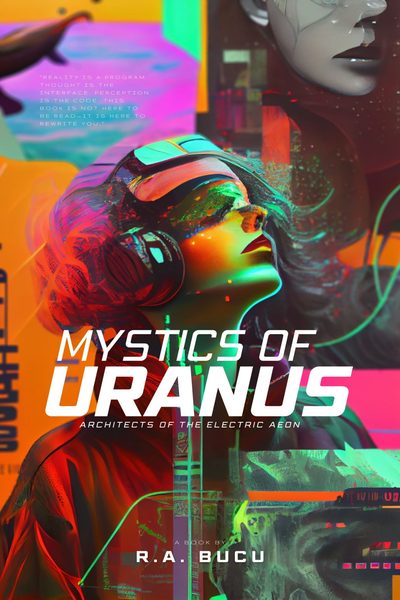
Mystics of Uranus
Architects of the Electric Aeon
- Kindle edition
- 340 pages
- English
- Ray Ann Bucu · R.A.999
Not sure yet? Read the free archive first.
In the Philippines? Order a signed copy, posted from Manila.
The argument
Where the first book asks who drew the boundary, this one is about the people who keep walking across it. Uranus is the traditional signature for exactly that figure: the disruptor, the sudden reversal, the idea that arrives without permission and cannot be un-thought once it has.
The book treats that symbolism as a language rather than a mechanism. It is not making claims about planetary influence. It is asking what a culture encoded when it gathered a particular cluster of human behaviour under a single sign, and why that cluster keeps producing the same recognisable figure in every era that has one.
An aeon, in this reading, is not a span of time. It is a set of assumptions with a shelf life. The architects are the ones who notice the expiry date early, and pay for noticing.
This is the more poetic of the two books, and deliberately so. Some things are more precisely described in the register of symbol than in the register of argument, and pretending otherwise is its own kind of imprecision.
What the book works through
- Uranus as a cultural signWhat the symbol collects, where it came from, and how to read an astrological language without having to believe in astrology.
- The shape of disruptionWhy the figure that breaks a consensus tends to arrive from outside it, and what that costs the person who does it.
- The Electric AeonThe current turn: acceleration, dissolved institutions, and what a period of rapid reordering does to people living inside it.
- Creative dissent as a disciplineThe difference between breaking something because it is broken and breaking something because breaking feels like proof of vision.
- Living in a reorderingWhat holds when the inherited frame stops working, written for people who are already in that position.
Who it is for
Readers who use symbolic systems as lenses rather than as prediction. Anyone working in a field that is being rearranged underneath them. Readers of the first book who want the same concerns handled in a more open register, and readers who would start here and work backwards.
If you want a natal-chart handbook, this is not that. The astrology is a vocabulary the book borrows, not a service it provides.
Read these first
Four essays from the free archive in the same register. If the voice lands, the book is where it runs at length.