 Ray Ann Bucu
The archive →
Ray Ann Bucu
The archive →
Book one · History and philosophy
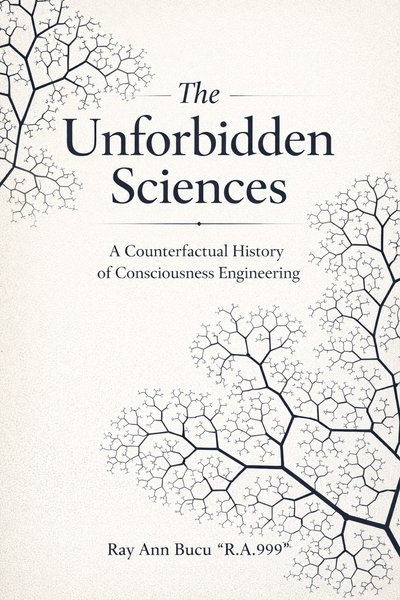
The Unforbidden Sciences
A counterfactual history of consciousness engineering
- Kindle and paperback
- 385 pages
- ISBN 9798252938103
- English
- Ray Ann Bucu · R.A.999
Not sure yet? Read the free archive first.
In the Philippines? Order a signed copy, posted from Manila.
The argument
Every society draws a line between inquiry that counts and inquiry that does not. The line feels like a description of reality. It is closer to a decision, made by particular people, in particular rooms, for reasons that were rarely only about evidence.
This book follows that line where it runs through the study of consciousness. It takes seriously a possibility that is usually dismissed before it is examined: that some of the traditions filed under superstition contained disciplined, repeatable methods for investigating human experience, and that those methods were discarded along with the metaphysics they arrived wrapped in.
The counterfactual in the subtitle is not a fantasy. It is a method. If you want to see the shape of a boundary, the most useful question is not whether it is correct but what a serious research programme on the other side of it would have looked like. Ask that carefully and the boundary stops being invisible.
None of this asks you to adopt a belief. It asks you to notice that the sorting happened, that it had authors, and that the categories you inherited were built rather than found.
What the book works through
- Who draws the boundaryThe institutions that decide what counts as legitimate inquiry, and the mechanisms by which a question stops being askable inside them.
- What gets filed under superstitionPractices with internal method and transmitted technique, and what happens to a technique once its cosmology is discredited.
- The counterfactual programmeWhat a rigorous science of consciousness might have looked like had it developed continuously rather than in exile.
- The cost of the sortingWhat was lost, what survived in disguise, and which of the discarded questions have quietly returned under new names.
- What to do with any of itHow to hold an unresolved question without either believing it or dismissing it, which is the harder discipline.
Who it is for
Readers of the history and philosophy of science who want the sociology of knowledge taken seriously rather than gestured at. Readers of religion and esoteric history who want argument rather than devotion. Anyone who has noticed that the phrase we already know that isn't real is doing a great deal of work and would like to see the work examined.
It is not a manual, it does not promise a practice, and it will not tell you what to believe. If you want certainty this is the wrong book. If you want a better class of question, it is the right one.
Read these first
Five essays from the free archive that run the same argument at shorter length. If they hold your attention, the book is the long version.